Installed Controls Are Not the Same as Effective Risk Reduction: Measuring Insider Risk Control Effectiveness
Are Your Insider Risk Investments Actually Reducing Exposure?
“I have sat through more program reviews than I can count where progress was summarized with a familiar collection of words: deployed, launched, completed, approved. Those are good words. They tell us work happened, but they do not tell us risk changed, and a green project plan is not a force field.”
Across government, national security, technology, and Fortune 500 environments, I have seen organizations invest heavily in controls that looked impressive on paper. The tools were installed. The policies were approved. Training completion approached 100 percent. Committees met on schedule and dashboards had enough green boxes to make everyone feel reasonably comfortable.
Meanwhile, broad access remained in place, important populations fell outside the control’s reach, exceptions accumulated, and response handoffs still took too long.
The control existed. So did the exposure.
Control Presence Is Not Control Effectiveness
Most organizations are reasonably good at documenting whether a control exists. They can tell you whether DLP is deployed, access reviews occur, training is mandatory, or an investigation process has been approved. These are important indicators of capability and maturity.
But control effectiveness asks a different question:Did the control measurably change the conditions creating insider risk exposure?
That distinction matters. A control can be fully implemented and still have limited effect. It may cover the wrong systems, exclude the people who create the greatest exposure, generate noise that overwhelms analysts, or operate too slowly to change the outcome. It may also work well in one part of the organization and poorly in another.
Presence is largely binary. Effectiveness is contextual.
The Missing Link in Insider Risk Metrics
The earlier articles in this series focused on several important measurement questions:
- Exposure tells us where the organization is vulnerable.
- Concentration shows us where that exposure is clustered.
- Coverage helps us understand what the program can actually see.
- Trend and velocity show whether conditions are improving, deteriorating, or changing faster than the organization can respond.
Control effectiveness connects those ideas to action. It asks whether the investments, policies, processes, and technologies being implemented are actually moving exposure in the right direction.
Without that connection, a program may be able to report activity but still struggle to prove value.
❌ "We deployed a new control" is an implementation update.
✅ "We reduced exposure within a critical population and strengthened our ability to detect and contain harmful activity" is a risk-management outcome.
Executives tend to appreciate the difference.
Give Your Controls Some CRED
Before declaring a control effective, I recommend testing its **CRED**:Change. Reach. Evidence. Durability.
This is not a complicated mathematical model. It is a practical set of questions that can improve the quality of almost any program review.
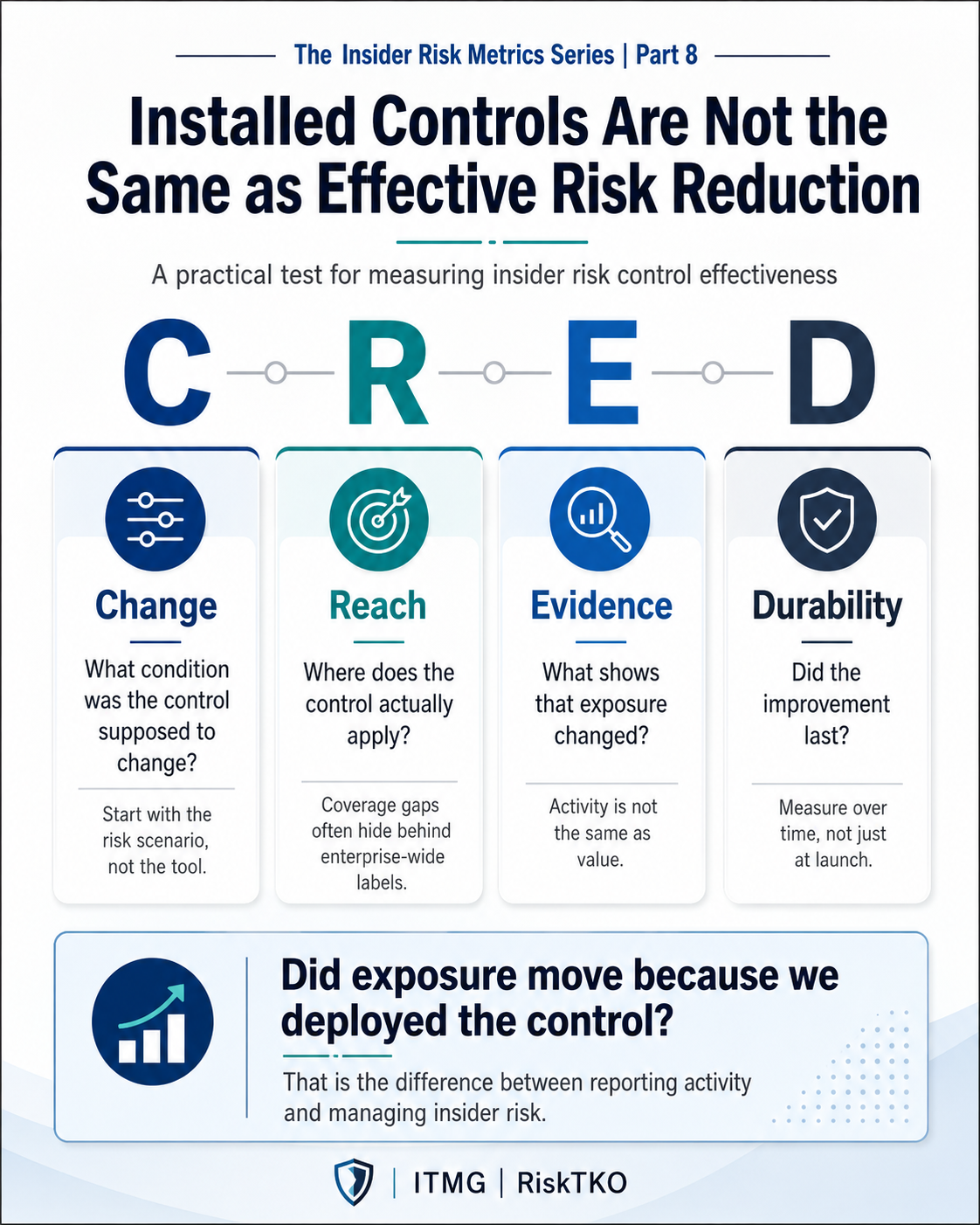
Figure 1: The CRED Framework — Change, Reach, Evidence, and Durability as the four pillars of real insider risk control effectiveness.
CChange: What condition was the control supposed to change?
Start with the risk scenario, not the tool. Was the control intended to narrow access, make harmful action more difficult, improve visibility, accelerate detection, strengthen containment, or support a more defensible decision?
The expected change should be clear before implementation begins. Otherwise, the organization may end up measuring whatever data the tool happens to produce. That is how alert volume becomes a success metric. More alerts might mean better visibility. It might also mean more noise. Without an expected outcome, it is difficult to know which one you purchased.
RReach: Where does the control actually apply?
A control cannot reduce exposure where it does not operate. This sounds obvious, but coverage gaps often hide behind enterprise-wide labels. A control may be described as global while excluding contractors, service accounts, acquired environments, cloud applications, unmanaged devices, or privileged workflows.
I have seen controls work exactly as designed while failing to address the population or asset creating the greatest exposure. That is not necessarily a technology failure. It is often a scope and prioritization failure. Ask who is covered, what is covered, and where meaningful exceptions remain. Then compare that reach to where insider risk is concentrated.
🎯 A control applied broadly to a low-exposure population may produce less value than a targeted control applied to a smaller but significantly more consequential group.
EEvidence: What shows that exposure changed?
Completion rates, deployment percentages, alert counts, and meeting attendance can all provide useful operational information. None proves effectiveness by itself. Evidence should show a defensible connection between the control and a change in risk conditions.
Consider access reviews. Completing every scheduled review may demonstrate process discipline. But if unnecessary standing privileges remain in place, the process has not yet produced the intended risk outcome. The same applies to training. A 99 percent completion rate looks excellent in a presentation. If the content does not address the decisions, workflows, and access conditions of the populations creating the greatest exposure, the organization may have completed training without meaningfully changing risk.
You do not need proof beyond a reasonable doubt. I say that as a former prosecutor. But you do need more than a vendor slide and a hopeful interpretation of an upward-trending chart.
DDurability: Did the improvement last?
Controls do not deserve lifetime tenure. Organizations change. People move between roles, applications migrate to the cloud, acquisitions introduce new environments, business processes evolve, and exceptions that were supposed to be temporary develop remarkably successful careers.
A control that was effective six months ago may be less effective today. That is why control effectiveness should be measured over time rather than declared once at implementation. Programs should look for degradation, displacement, new blind spots, and changes in the exposure the control was designed to reduce.
This is where trend and velocity become especially important. A control may initially reduce exposure, but the benefit can fade as conditions change. Another control may appear slow to deliver value but produce sustained improvement over several reporting periods.
⏳ The goal is not to reward the fastest project. It is to understand which investments create durable risk reduction.
Where Programs Commonly Get Fooled
One common mistake is treating control activity as control value. A DLP tool may generate more alerts after a new policy is enabled. That does not necessarily mean the organization is safer. It may mean the organization can now see activity it previously missed, which is useful, but different from proving that exposure declined.
Another mistake is evaluating controls only at the enterprise level. Insider risk is not evenly distributed, and neither is control effectiveness. A monitoring capability may perform well for employees on managed devices while providing little visibility into contractors or privileged administrators using different systems. Enterprise averages can hide that difference.
Programs also tend to measure controls individually, even though outcomes often depend on how controls work together. Strong detection with weak containment may identify a problem without limiting harm. Excellent policies with poor technical enforcement may establish expectations without changing behavior. Mature investigation procedures with unreliable escalation may still leave leaders waiting for the information needed to act.
The question is not whether every control looks good by itself. The question is whether the overall control environment changes exposure where it matters.
Why This Matters for Budgets
Insider risk leaders are routinely asked to justify investments. That conversation becomes difficult when the program can report only what it purchased, completed, or deployed. Leadership may reasonably ask what changed as a result.
Control-effectiveness metrics help answer that question. They give programs a better way to explain why one investment should be expanded, another should be adjusted, and a third may no longer justify its cost. They also help distinguish between a control that is ineffective and one that has simply been applied to the wrong problem.
That distinction protects budgets as much as it challenges them. A control that cannot yet demonstrate measurable movement is not automatically a bad investment. It is an unproven one. The next step should be better evidence, clearer targeting, or a more realistic understanding of the result it was expected to produce.
Start With One Control
You do not need to launch a six-month measurement initiative to begin. Before your next steering committee meeting, choose one significant insider risk investment and ask:
Targeted Change
What condition was it expected to change?
Reach & Target
Does it reach the populations and assets driving exposure?
Defensible Evidence
What evidence shows that the condition improved?
Sustained Durability
Has the improvement held over time?
The answers will usually reveal more than another slide showing deployment status. They may also expose a larger challenge. Computing control effectiveness consistently requires organizations to connect assessment results, control coverage, relevant populations, risk scenarios, remediation work, and changes in exposure over time.
Conceptually, that is straightforward. Operationally, it becomes difficult very quickly.
That challenge is one reason we built RiskTKO. The objective is not to give every control another vanity score. It is to create a living view that connects program actions to changing exposure, so leaders can see what is working, where it is working, and what should happen next.
Because the real question is no longer: "Did we deploy the control?"
It is: "Did exposure move because we did?"
That is the difference between reporting activity and managing insider risk exposure.